How to Confidently Accompany a Wine Tasting: My Tips
Reading time: 11 minutes
Accompanying a wine tasting without deep wine expertise is a situation many companions in upscale lifestyle dating know well. Last week a business partner invited me to an exclusive tasting of the 2019 vintage at the Weinhaus Balthasar Ress in Hattenheim. Standing there among Rieslings from the Rheingau, it struck me once again: it isn't about reaching sommelier level but about coming across as confident and interested without pretending to be someone you're not.
Over the past few years I have learned that genuine interest and the right preparation matter more at wine tastings than half-knowledge picked up from reading. After accompanying more than 15 wine tastings in Germany, Austria and Switzerland, I'm sharing the proven strategies that have helped me move confidently in this exclusive world.
Preparation makes the difference at a wine tasting
Before I accompany a wine tasting, I invest at least 90 minutes in preparation. That sounds like a lot, but the time pays off. I research the winery or the organizer and memorize three or four facts. For a tasting at Schloss Johannisberg, for example, I remembered that this estate was the first in the world to grow Riesling, in 1720. Details like these show interest without my having to resort to wine-expert jargon.
In addition, I look at the wine region. If we're traveling to Bordeaux, I read up on the appellations Pauillac or Saint-Émilion. Not to shine, but to be able to ask questions. According to a 2023 study by the German Wine Foundation (Deutsche Weinstiftung), 64 percent of wine tasting participants in Germany attend at most two tastings per year. So most people aren't experts, and asking smart questions is appreciated.
Another point of my preparation: I note down the grape varieties that will likely be tasted. At an Austrian wine tasting those were Grüner Veltliner and Zweigelt, in the Pfalz Pinot Noir (Spätburgunder) and Riesling. I don't need to know exactly how these grapes taste, but the names should be familiar to me.
Wine tasting etiquette: what really counts
Wine tasting etiquette differs from normal restaurant rules. The most important thing first: I never wear strong perfume. At a tasting at Weingut Dr. Loosen on the Moselle, I saw how a participant's intense fragrance made the sommelier visibly wrinkle his nose. Since then, on days like that I use only a subtle deodorant and no perfume.
I always hold the glass by the stem, never by the bowl. The warmth of your hand changes the temperature of the wine, and people notice. I swirl the glass lightly to release the aromas, but not excessively: two or three gentle circles are enough. When smelling, I hold the glass at about chest height and breathe in calmly, without sniffing theatrically.
When tasting, I take a small sip and let it rest briefly in my mouth before I swallow or spit it into the spittoon provided. Yes, spitting is part of it, especially when ten or more wines are tasted. At first I found this strange, but it is professional and shows that I came to experience the wines, not to drink. A 2022 study by the German market research institute GfK (Gesellschaft für Konsumforschung) shows that professional wine tasters spit 89 percent of the time at tastings with more than eight wines, to keep their senses sharp.
As I described in my article on table manners on a first date, restraint and observation are fundamental skills in an upscale setting, and they prove their worth at wine tastings, too.
Showing competence without faking expertise
The biggest mistake I made early on: I tried to impress with memorized terms. At a tasting in Burgenland I described a wine as "very mineral" without knowing what that means. The winemaker asked a follow-up question, and I stood there embarrassed. Since then I stick to honest descriptions.
I'd rather say "I taste something fruity here, maybe apple?" than "Distinct tertiary aromas with oxidative notes." Authenticity is appreciated. When the sommelier talks about "tannins" and I'm not sure, I ask: "Is that the slightly fuzzy feeling on the tongue?" Questions like that show that I'm learning, not that I'm clueless.
At a tasting at Weingut Van Volxem on the Saar, I applied this strategy. About a Riesling I said: "I notice that this wine feels almost sparkling on the tongue. Where does that come from?" The winemaker enthusiastically explained the natural carbon dioxide in young Rieslings. The conversation was authentic and instructive, and nobody felt put on the spot.
The art of asking the right questions
For every wine tasting I prepare three open questions. These questions relate to the winery, the growing methods or the winemaker's philosophy. Examples from my practice: "How did the dry summer of 2022 affect your harvest?" or "Do you work with barrique barrels or do you prefer stainless steel tanks?"
Questions like these show interest in the winemaker's work, not in wine as a status symbol. According to the German Wine Institute (Deutsches Weininstitut), around 71 percent of the wineries surveyed in 2023 said that they find visitors who ask about production processes especially appreciative.
A confident presence at wine tastings as a companion
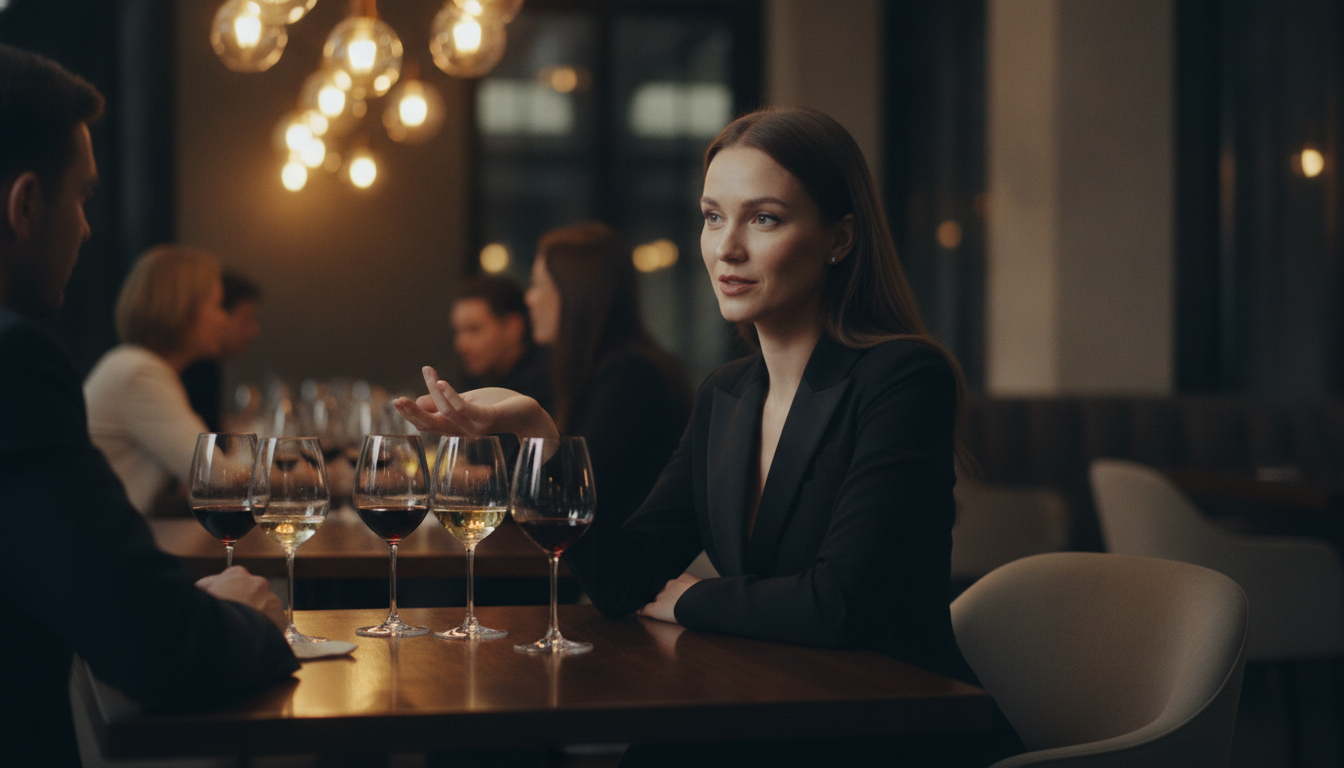
As a companion at a wine tasting, my role is different from that of the business partners. I'm not the main person, but I'm not invisible either. My goal is to enrich the atmosphere without taking center stage. That means: I listen attentively, nod in agreement, and smile when something interesting is explained.
When my companion buys a bottle, I remark discreetly: "A good choice, I really liked this wine too." That shows I was paying attention. I avoid commenting on purchasing decisions myself or bringing up the price, though. At a tasting at Weingut Künstler in Hochheim, my companion bought six bottles of a 2018 Pinot Noir for a total of $460. I praised the wine, not the purchase.
Clothing plays a role as well. At wine tastings I wear elegant but unobtrusive outfits. A simple dress in navy or charcoal, subtle jewelry, flat shoes or small heels. At wineries we often walk through cellars with cobblestone floors, and high heels are impractical and look out of place.
Learning wine culture, step by step
I didn't know everything right away, and that isn't necessary. I built up my wine education over months, in a structured way. These steps helped me:
- I attended a wine basics event at the IHK Frankfurt (the Frankfurt Chamber of Commerce and Industry), which took place over two evenings and cost $200. There I learned about the most important European wine regions, grape varieties and the basics of tasting.
- I read the book "Wine" by André Dominé, a comprehensive standard work of 928 pages. I didn't read all of it but looked up chapters on regions that were relevant to my engagements: Bordeaux, Burgundy, Rheingau, Piedmont.
- I used free online courses. The platform Wine Folly offers beginner-friendly graphics and explanations of wine regions and flavor profiles. There I learned how to classify wines by body, acidity and tannin.
- I attended public wine tastings in my city. Many wine shops offer monthly tastings for $30 to $50. There I could practice in a relaxed atmosphere without the pressure of a business event.
After about four months I felt confident enough to accompany any wine tasting with poise. I haven't become an expert, but I can hold a conversation, ask fitting questions and enjoy the evening without feeling uncomfortable.
Avoiding typical mistakes at a wine tasting
From experience I know which mistakes can become embarrassing. I avoid rejecting a wine after the first sip. Even when I don't like a wine, I say politely: "Interesting, that's not my preferred style, but I recognize the quality." At a tasting at Weingut Reichsrat von Buhl in the Pfalz, I didn't like a very dry Riesling. Instead of rejecting it, I said: "This wine is very clear and straightforward. I prefer a bit more fruit." That was honest but respectful.
Another mistake: I never add water to my glass to dilute the alcohol. That is absolutely taboo at wine tastings. If I want to consume less alcohol, I spit or take smaller sips. I also avoid emptying my glass completely after every wine. That signals that I'm there to drink, not to taste.
I also never speak disparagingly about wines from certain regions or price ranges. At one tasting I heard a companion say: "German wine can't keep up with French wine anyway." The host was a winemaker from Franconia. The mood tipped immediately. Respect for every wine region and every producer is essential.
Body language and attentiveness
My body language at wine tastings is open and engaged. I stand or sit upright, don't cross my arms and keep eye contact with the speaker. When the sommelier is explaining something, I put my smartphone away. I have seen a quick text message during an explanation come across as disrespectful.
Similar to the art auctions I accompany, wine tastings are also about winning people over through presence and genuine interest, not through feigned expertise.
Wine tasting behavior: discreet and elegant
Discretion goes without saying at upscale wine tastings. I don't talk about other participants, their comments or their purchasing decisions. What is said at a tasting stays there. At an exclusive tasting at Weingut Egon Müller on the Saar, several well-known personalities were present. Afterwards I never mentioned whom I had met there.
I also don't take photos without asking. Many wineries allow photos, but I always ask first. When I do take a photo, it's discreet and without flash. Selfies at wine tastings look unprofessional, and I've held back from them from the start.
After the tasting I thank the host or sommelier personally. A brief handshake, a smile and a sincere "Thank you so much for the fascinating insight" leave a positive impression. After a tasting at Weingut Wittmann in Westhofen, I wrote the winemaker a handwritten thank-you card two days later. It isn't necessary, but it's appreciated.
FAQ: accompanying a wine tasting
How do I professionally accompany a wine tasting without wine knowledge?
You can accompany a wine tasting professionally by preparing, staying authentic and asking smart questions. Research the winery and the region, get to know the most important grape varieties and show genuine interest. Avoid faking expertise. Honest questions like "How did the 2022 vintage affect your harvest?" come across as more competent than memorized terms you can't explain. Prepare for 90 minutes and focus on observation and respectful behavior.
What do I need to know about wine tastings as a stylish companion?
As a stylish companion, you should know the basic wine tasting etiquette: don't wear strong perfume, hold the glass by the stem, swirl it only lightly and spit when there are many wines. Dress elegantly but practically. Ask questions about the winery and the production processes, not about prices. Stay discreet, respect the winemaker's work and show attentiveness. Basic knowledge of the most important German and French wine regions and the differences between grape varieties such as Riesling, Pinot Noir and Chardonnay is perfectly sufficient.
Why should I spit instead of swallowing at wine tastings?
Spitting at wine tastings is professional and necessary when more than six to eight wines are tasted. It keeps your senses clear and prevents alcohol from impairing your judgment and perception. According to the 2022 GfK study, 89 percent of professional tasters spit at extensive tastings. That shows you want to evaluate the wines seriously and not simply drink. Spittoons are provided at every reputable wine tasting, and using one is not a sign of weakness but of professionalism.
How should I behave if I don't like a wine at a tasting?
If you don't like a wine, stay polite and respectful. Never say outright "I don't like this" or "That's not a good wine." Say instead: "That's not my preferred style" or "I recognize the quality, but I prefer something more fruit-forward." You can also say: "Interesting, very dry. I need a little more time to get used to this style." Phrases like these show that you respect the wine even if it isn't to your taste. Avoid disparaging comments about regions or price ranges.
What preparation do you recommend for your first wine tasting as a companion?
For your first wine tasting, plan at least 90 minutes of preparation. Research the winery online, memorize three facts and read about the wine region. Get to know the most important grape varieties that will be tasted. Beforehand, attend a public wine tasting in your city or complete an online basics course on platforms such as Wine Folly. Prepare three open questions about growing methods or vintage differences. On the day of the tasting, skip the perfume and dress elegantly but practically. This preparation gives you confidence and lets you carry yourself with poise.
My personal conclusion on accompanying wine tastings
Accompanying a wine tasting without being a wine expert is not a disadvantage. It's an opportunity to show genuine interest, to learn and to stay authentic. Over the past few years I have learned that respect, preparation and curiosity matter more than memorized expertise. I don't have to be able to judge every vintage, but I can ask questions that show I value the winemaker's work.
The most important takeaways from my experience: prepare in a structured way, stay honest, avoid strong perfume, hold the glass by the stem and ask open questions. As with many aspects of upscale lifestyle dating, it comes down to the right balance between competence and modesty. If you take these principles to heart, you'll handle any wine tasting with poise, without having to pretend to be someone you're not.
If you want to further develop your skills in discreet companionship, I also recommend my article on inner strength and true professionalism. The principles described there apply universally to all upscale occasions where poise is called for.